The majestic city of Alatri, inhabited by the Ernici, an Italic people belonging to the Osco-Sannitic group, is an authentic treasure chest of history, culture and art. This ancient center came into contact with Rome during the royal period in the fifth century B.C. and later flourished as a Roman municipium of considerable importance. During the Middle Ages, Alatri became a significant bishopric, going through ups and downs but always remaining linked to the Church. However, in 1798, the city fervently joined the Jacobin republican movement, demonstrating its boldness and determination.
The acropolis of Alatri, a complex of megalithic buildings, stands out among the wonders of the Mediterranean area. Its majestic polygonal opera wall is dominated by two monumental gateways: the Porta Maggiore, which features an extraordinary monolithic lintel, and the Porta Minore, equipped with an inclined plane to reach the top of the acropolis. Here, the pagan temples were torn down to make room for the Cathedral and the Episcope. It is inside the Cathedral that the famous relic of the Incarnate Host, a miracle dating back to 1227, is kept. A second wall circuit, also in polygonal work, stretches for more than 2 km, enriched in the Middle Ages by mighty quadrangular towers that reinforced the city gates.
Medieval Alatri is made eternal by remarkable monuments. The church of Santa Maria Maggiore houses the striking wooden group of the Madonna of Constantinople (13th century) and the Triptych of the Redeemer by Antonio di Alatri. The 13th-century Palazzo Gottifredo houses the civic museum, which, in addition to an anthropological section with unusual objects such as an iron cradle between two trees, used by charcoal burners to protect infants from animals, includes an important epigraphic section. Prominent among the inscriptions is one that describes the works commissioned by censor Lucius Betilienus Varus during the Roman Republic to renovate the city.
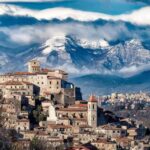
Through the centuries, Alatri has known moments of obscurantism and subjugation, but it has also experienced fervent periods of cultural and religious ferment. Today, this enchanting city, situated on a hill surrounded by olive groves, is a renowned tourist center thanks to its archaeological and medieval testimonies, as well as the numerous cultural and folkloric events that make it an authentic jewel of Ciociaria.
In the historic center of Alatri, the acropolis with its cyclopean walls dating from the 6th-5th centuries B.C., along with the mighty Gates, including the Porta dei Falli, tell ancient stories. The fresco of Christ in the Labyrinth and the sumptuous 13th-century Gottifredo Palace are further reminders of this glorious past. Artistic masterpieces and spiritual treasures are hidden in the city's churches, including the 13th-century Collegiate Church of Santa Maria Maggiore. St. Paul's Cathedral holds the Miracle of the Incarnate Host, while the 12th-century St. Stephen's Church exudes an aura of sacred solemnity.
Alatri is an enchanting crossroads of history and spirituality, nestled between its cyclopean walls and medieval churches. The city exudes a unique atmosphere, enriched by its vibrant culture and the splendor of its monuments, as it stands as an authentic jewel in the landscape of Ciociaria.

 Italian
  English