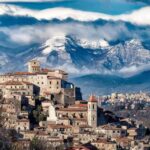
Suspended on a hill rising 214 meters above sea level, Ceccano represents the last offshoot of the Lepini Mountains toward the southeast, majestically dominating the Sacco Valley. In ancient times, before the arrival of the Romans, this area was inhabited by the valiant Volsci, an Italic people who erected an acropolis with mighty polygonal walls, the remains of which still surface in some places today. Ceccano's ancient name was Fabrateria, and the town distinguished itself for its resistance against Rome, later joining the capital in wars against the Samnites, thus increasing its importance.
Today's name of Ceccano dates back to the 7th century and was a tribute of the inhabitants to Petronius Ceccano, comes (Count) of Campagna, an ancient region south of Rome, and father of Pope Honorius I, in recognition of benefits granted. During the Middle Ages, Ceccano became strategically significant as it was located near the border between the Papal States and the Kingdom of Naples. Like many towns of the time, the village developed around a fortified castrum, with the population seeking refuge on a hill to escape barbarian raids.
Around the year 1000, the Counts de Ceccano took control of the city, and thanks to this family it became the capital of a vast county that lasted for about five centuries. This small state included more than 15 fiefdoms, stretching from the Amaseno Valley to the opposite slopes of the Lepini Mountains.
During the 15th century, with the disappearance of the last member of the de Ceccano family, the town came under the rule of the Caetani and later the Colonna family, who ruled it until the early 1800s. In the 17th century, Marcantonio Colonna, a descendant of the hero of Lepanto, granted Ceccano a renewed municipal charter.
During the Napoleonic period, French authorities contributed to the modernization of the town by building a large bridge across the Sacco River, again giving Ceccano a strategic role and boosting commercial traffic in the area.
In 1816, the Colonna family renounced their feudal rights over Ceccano, and their property was purchased by Filippo Berardi. This historical figure played a crucial role in the evolution of the town, making urban planning changes such as the construction of the railway station and an industrial zone in the lower part, known as Borgo Berardi.
During World War II, Ceccano suffered American bombing because of its strategic location near the front. After the war, the city experienced economic growth through the establishment of numerous industrial activities, radically transforming an economy that was once based primarily on agriculture.
Today, Ceccano is the fifth most populous city in the province of Frosinone and enjoys an extremely advantageous geographical location, easily reached by train and by car. The train station, located in the heart of the city center, allows visitors to easily explore the entire city on foot, while those traveling by car can take the A1 highway exit Frosinone, just a few kilometers away.
Ceccano is a town that holds a past rich in events and transformations, from ancient times to the present day. Among its main attractions are the majestic Castel Sindici, a neo-Gothic-style palace surrounded by a park declared a "National Artistic Zone," and the striking Sanctuary of Santa Maria a Fiume, an example of Gothic-Cistercian architecture enriched by Roman remains. The city is adorned with several churches, including the Collegiate Church of St. John the Baptist, which mixes medieval and baroque elements.
Ceccano, with its fascinating history and strategic location, continues to shine in the landscape of the province of Frosinone, attracting visitors with its cultural heritage and historical riches.

 Italian
  English